

Commentary
Rym Momtaz
{
  "authors": [
    "Rym Momtaz"
  ],
  "type": "commentary",
  "blog": "Strategic Europe",
  "centerAffiliationAll": "",
  "centers": [
    "Carnegie Endowment for International Peace",
    "Carnegie Europe"
  ],
  "englishNewsletterAll": "",
  "nonEnglishNewsletterAll": "",
  "primaryCenter": "Carnegie Europe",
  "programAffiliation": "",
  "regions": [
    "Europe",
    "Middle East",
    "Gulf",
    "United States"
  ],
  "topics": [
    "EU",
    "Foreign Policy",
    "NATO"
  ]
}
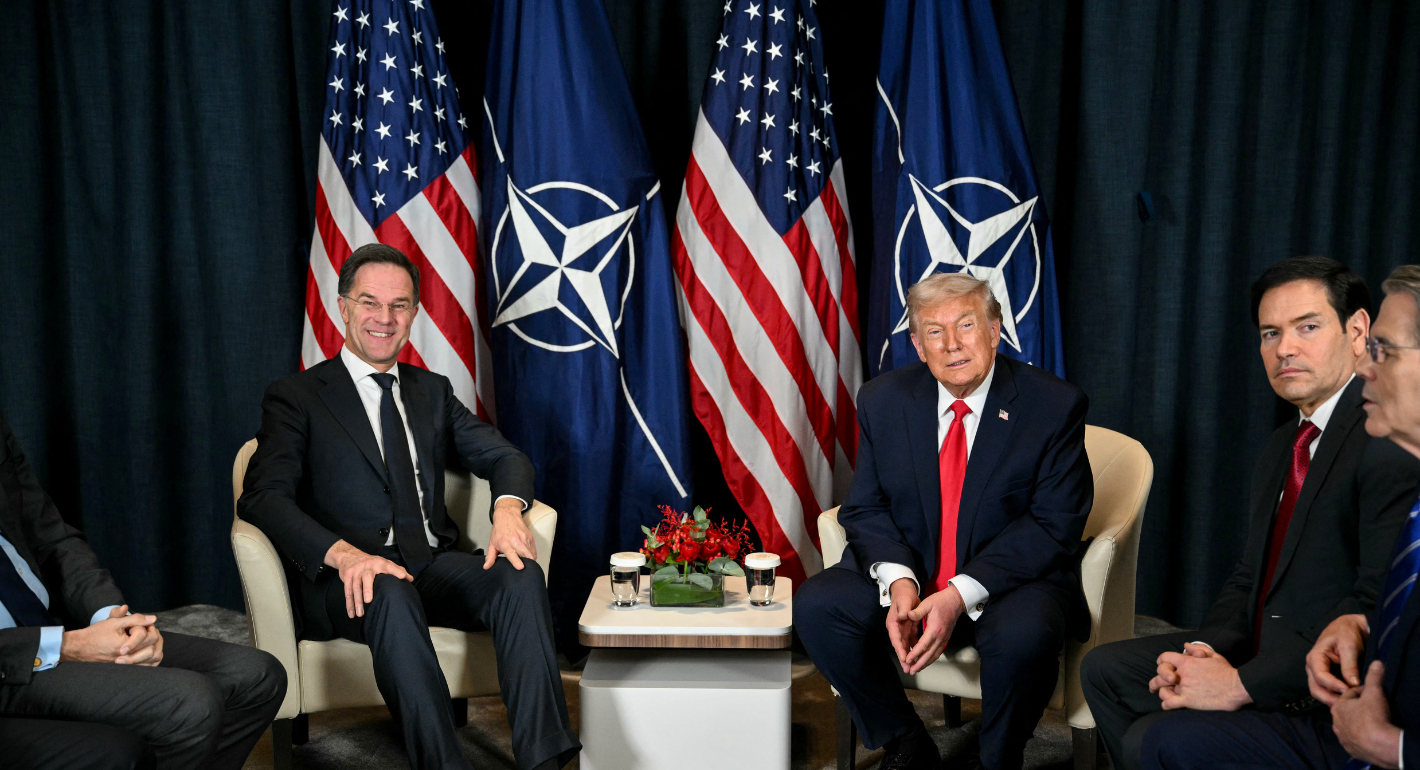
Source: Getty
Donald Trump has demanded that European allies send ships to the Strait of Hormuz while his war of choice in Iran rages on. He has constantly berated NATO while the alliance’s secretary-general has emphatically supported him.
Distinguished Fellow, Royal United Services Institute
NATO Secretary-General Mark Rutte is walking a tightrope to keep the alliance together, which is his job. He is publicly lavishing praise on U.S. President Donald Trump, while working the phones behind the scenes to find an off-ramp reflecting NATO’s collective interest. That has been his approach to disputes about defense spending, Ukraine, Greenland, and now the Strait of Hormuz.
Rutte has been involved in the joint statement by twenty-two NATO allies and other partners calling for immediate action to cease Iran’s strikes in the Gulf and open the Strait of Hormuz. He said that military planners were working to assess what is needed, where, and when, to achieve that goal. But this is unlikely to become an alliance mission, as many allies believe the conflict “has nothing to do with NATO.”
At the same time, allies cannot just stand on the sidelines. Ensuring freedom of navigation is in their interest, as is preventing Russia from using high oil prices to replenish its war coffers. NATO has consistently condemned Iran’s nuclear and ballistic missile programs and its destabilizing role in the region. And the alliance’s ballistic missile defense system was used for the first time in March, successfully intercepting three Iranian missiles heading towards Turkey.
Senior Fellow for Europe, Council on Foreign Relations
It is entirely understandable why European NATO allies are reluctant to support Donald Trump’s war against Iran. He neither coordinated with allies nor provided a coherent strategy for how to win it. What’s more, he’s been berating them and trying to coerce their support. For European leaders, participating in a war of questionable legality carries real political and legal costs at home.
However, they should take a sober look at their own interests and at the range of outcomes this war can lead to now that it is already underway, with a view to contributing to a best-case outcome rather than the worst case. High energy prices and the risk of migration flows from a destabilized region are real.
If Europe stays out, it will have no influence over the outcome, undermining its ambition to be a global actor. Limited contributions, politically, diplomatically, or military, should be on the table.
Understandably, Europeans do not want to pick up the pieces of Trump’s war. But it may well be in their own interest do so—not as a favor to Trump, but because the outcome matters to Europe, too.
Senior Fellow, Strategic Studies Program, Observer Research Foundation
NATO allies should not get involved in offensive operations against Iran alongside the United States, nor is it their job to support this war of choice.
This war is as incoherent as it is misguided, and it puts America’s European allies in the worst possible position: stuck between public opinion, their relationship with Washington, and their own continental security. The problem for Europe is that they end up bearing the brunt of these decisions, whether they get directly involved or not.
If Europeans stay out, they’ll pay the economic price with skyrocketing energy costs and inflation, while facing continued criticism by the White House for not helping solve the crisis. This could ultimately mean the United States weaponizes support for Ukraine or its membership in NATO.
For countries that do choose to get involved, they could face domestic backlash or risk Iranian retaliation.
And depending on how long this goes on, the public backlash from a deepening economic crisis will be just as damaging as any backlash from direct engagement in the war.
But Europeans are not just frustrated with the United States, they are actively questioning why they should continue standing by an ally that repeatedly places them in untenable positions.
Managing Director for Strategic Foresight and Director of the Paris Office, German Marshall Fund of the United States
NATO’s main goal is self-defense; acting in solidarity to respond to an attack against one of its thirty-two members. The war on Iran that the U.S. president started with Israel doesn’t meet that standard.
Despite statements by the NATO secretary-general, the alliance’s purpose is not to come to Washington’s aid to mitigate the effects of a self-inflicted wound.
European leaders have clearly conveyed to Donald Trump their unwillingness to act at his side, as “this is not Europe’s war.” And they are growing increasingly frustrated with the secretary-general’s forward-leaning statements toward Trump.
While maintaining the cohesion of the alliance is front and center to the secretary-general’s job description, he cannot cater solely to the president’s whims, especially as he continues attacking his European counterparts.
Nevertheless, it is also now evident that European countries are deeply shaken and directly impacted by the war in the Middle East: the blockade of the Strait of Hormuz, the unravelling of the global economy, as well as uncertainty over the ability to travel and over the duration of the ongoing war. When they act, it will be to defend their interests in the region and beyond, not to please Donald Trump.
Nonresident Senior Fellow, Atlantic Council
Major European capitals should not get involved militarily in the current war, or cave to political blackmail by the U.S. president. NATO’s sole goal is to mutually defend the alliance’s members, not to unconditionally back America’s efforts to topple an otherwise abhorrent regime in the Middle East.
Since NATO’s inception in 1949, all American presidents have considered the alliance an asset. But the current administration perceives it as a burden.
Whenever Donald Trump addresses the organization’s present and future, his remarks are peppered with caustic barbs targeting European allies, who he claims are “ungrateful” and “would never be there” if America “needed them.” He views NATO as detrimental to American interests worldwide, and when asked about the probability of the United States’ departure from the alliance, Trump has never unequivocally ruled it out.
Moreover, in Trump’s narrow America First perception of foreign relations, every alliance should serve as a vehicle for the pursuit of his country’s global priorities. This illustrates his misunderstanding of the West’s set of common values, including shared responsibility and appreciation for other members’s contributions.
Quite obviously, Trump refuses to acknowledge the very definition of NATO as a team of equals. He doesn’t share wins, but he eagerly shares fiascoes.
Head of the Research and Analysis Office, Polish Institute of International Affairs (PISM)
On the one hand, the United States needs allies to underwrite its strategy toward the Middle East for a number of reasons. On the other hand, the allies can’t afford to not have a region-specific platform to engage with America. So, they had better act before broader damage is done both to transatlantic relations and the Western economy.
It's not a matter of if, but when: NATO allies will get involved, in one way or another, in stabilizing the Middle East. And it will be neither surprising nor unprecedented.
First, Europe has vested interests in a stable supply of hydrocarbons from the Gulf. The EU’s economy—which has just undergone a costly divestment from Russian gas and oil—badly needs stable energy prices.
Second, NATO forces have been almost permanently present in the Middle East over the last two decades. Not long after the United States under president George W. Bush launched Operation Iraqi Freedom, which caused a deep rift in transatlantic relations, allies established a NATO Training Mission in Iraq. Its indirect successor, operating in Iraq since 2018, was evacuated on March 18, 2026. Meanwhile, numerous European ships have been engaged in the anti-piracy operations of the EU and other coalitions, including to protect commercial ships from Iran-sponsored Houthis.
Director, Geopolitics and Security Studies Center
Europe has to act in favor of its core security interests. Keeping the United States engaged in European security for the foreseeable future is at the top of the list. Years of defense investment neglect have consequences, and some verbal gymnastics to please Donald Trump, while unpleasant, are a bearable cost.
However, European countries should have a more combative and coordinated narrative. They should emphasize how essential Europe is for the United States—strategically and logistically. The U.S. Ramstein Air Base in Germany, and others, are proving crucial for the current war effort. This contradicts the Trumpian narrative of allies as a burden and the transatlantic relationship as a one-way street.
Armed with such a focused narrative, European countries do not need to involve themselves in offensive operations, which are clearly a no-go politically and unsustainable militarily.
European countries are good at saying no—often rightly so—but less efficient at proposing practical solutions. Iran has posed a direct threat to European security interests for years, not least by aiding Russia’s war machine. Yet it took days to formulate the idea of helping ensure security in the Strait of Hormuz after the war, as if the U.S. military buildup beforehand had not made such scenario-based planning possible.
Director, Global Public Policy Institute
“This war is not a matter for NATO,” German Chancellor Friedrich Merz said on March 16, bluntly ruling out committing his country’s military to an active war. He is right.
It is wrong for Mark Rutte to play chief cheerleader of a disastrous war of aggression started without consulting any NATO allies.
Previous efforts to keep Donald Trump on NATO’s good side—such as his now-infamous “daddy” remarks—might have been cringeworthy, but were well-intentioned. And in the case of Greenland, they combined with European pressure to prove somewhat effective. But here, Rutte clearly oversteps his mandate. He would be well advised to check back with his team on his claim that the current war will make a nuclear-armed Iran less likely.
This war is one big global advertisement for getting nuclear weapons fast. And Iran won’t be the only country reaching that conclusion. At the same time, it’s a good call for Merz to offer support for diplomacy with Iran and German involvement in securing freedom of navigation once there is an agreement. For the rest, European NATO members should finally overrule Rutte and offer a clear timetable for taking over critical enablers for European defense currently provided by the United States.
Deputy Director, Center for Eastern Studies (OSW)
No, NATO allies should not get involved in offensive operations against Iran. But they should be ready to engage in stabilizing the Middle East after the war is over.
Several countries, including France, Germany, the UK, Italy, and the Netherlands, have already announced their intention to contribute to securing maritime transport routes in the Persian Gulf once hostilities in Iran have ceased. The most likely scenario might be the establishment of an international coalition of the willing involving European navies and, to a certain extent, air forces tasked with reconnaissance and monitoring, as well as the potential neutralization of threats on land.
The stabilization of the Middle East could become, however, a central item on the agenda of the NATO summit in Ankara in July 2026, where Donald Trump may threaten a U.S. withdrawal from the alliance while also seeking allied support, for instance in ensuring the military protection of oil and gas infrastructure in the Gulf states or in mine-clearance operations in the Strait of Hormuz.
The allies should answer that call, not only due to the need to secure the transatlantic link, but also because of their own economic interests.
Senior Fellow and Director of the American Statecraft Program, Carnegie Endowment for International Peace
If European leaders think they are pulling a lever in Washington by not getting involved, they should check whether that lever is connected to anything. Trump isn’t really worried about the loss of European support—he’s using Europe as another scapegoat to deflect blame for a failing war. History proved principled opposition to the Iraq war right in the end, but opposition didn’t stop history.
The deeper risk is that principled opposition draws attention to a serious security lacuna yet again: Europe cannot project military power beyond its borders in any way that meaningfully advances American interests. It can’t even do much militarily to defend the U.S. homeland. Opposition to this war thus doesn’t just fail to stop it—it reminds Americans of this yawning gap. European leaders are right that this is war is a mistake, but being right will be costly. To many Americans, they are making Trump’s case for decoupling all by themselves.
Senior Program Manager, GLOBSEC
The U.S. war against Iran comes at the lowest point in the history of transatlantic relations. Nevertheless, NATO is a collective defense alliance, not a tool for advancing the agenda of a single leader—including president Trump. Its founding principle, Article 5, says an attack against one member is considered an attack against all, making its mission fundamentally defensive rather than offensive.
Decisions within the alliance are made through consensus among all member states, reflecting shared interests rather than unilateral ambitions. The involvement of allies in this war risks sending the controversial message that the wishes of the U.S president can actually lead the decisions of NATO.
The alliance’s credibility depends on its commitment to international law and multilateral cooperation. If it were seen as endorsing the discretionary military policies of one country, it could weaken internal cohesion and damage its global standing.
At the same time, European involvement in the war would also suffer from a significant lack of popular legitimacy across Europe, where public opinion remains deeply skeptical of another Middle East conflict.
The continuous threats coming from President Trump only contribute to deepening the distance between Washington and the European capitals—and weaken what the allies have built in the past seventy-seven years.
Subscribe to Strategic Europe, delivered to you weekdays!

Editor in Chief, Strategic Europe
Rym Momtaz is the editor in chief of Carnegie Europe’s blog Strategic Europe. A multiple Emmy award-winning journalist-turned-analyst, she specializes in Europe and the Middle East and the interplay between those two spaces.
Recent Work
Rym Momtaz
Rym Momtaz, ed.
Carnegie does not take institutional positions on public policy issues; the views represented herein are those of the author(s) and do not necessarily reflect the views of Carnegie, its staff, or its trustees.
The EU is structurally incapable of reacting to today’s foreign policy crises. The union must fold the EEAS into the European Commission and create a security council better prepared to take action on the global stage.

Stefan Lehne
The war in Ukraine is costing Russia its leverage overseas. Across the South Caucasus and Middle East, this presents an opportunity for Europe to pick up the pieces and claim its own sphere of influence.


William Dixon, Maksym Beznosiuk
The war in Iran proves the United States is now a destabilizing actor for Europe and the Arab Gulf. From protect their economies and energy supplies to safeguarding their territorial integrity, both regions have much to gain from forming a new kind of partnership together.
Rym Momtaz

French President Emmanuel Macron has unveiled his country’s new nuclear doctrine. Are the changes he has made enough to reassure France’s European partners in the current geopolitical context?
Rym Momtaz, ed.
European reactions to the war in Iran have lost sight of wider political dynamics. The EU must position itself for the next phase of the crisis without giving up on its principles.

Richard Youngs